
How to Find Providence County Probate Records
Probate records do not sit in the state court system. They live with the city or town probate court. So the first step is to find where the person lived or where the estate belongs. For a Providence resident, that is the Providence Probate Court. For other Providence County towns, it is that town's probate court.
Probate is set up by state law but run locally. Probate Court is established under R.I. Gen. Laws Title 8, Chapter 9, and the practice rules sit in Title 33. The Providence Probate Court page is the model for how a city court explains its jurisdiction and forms. You can read the governing law through the probate practice and procedure title, which frames how every Rhode Island probate court runs.
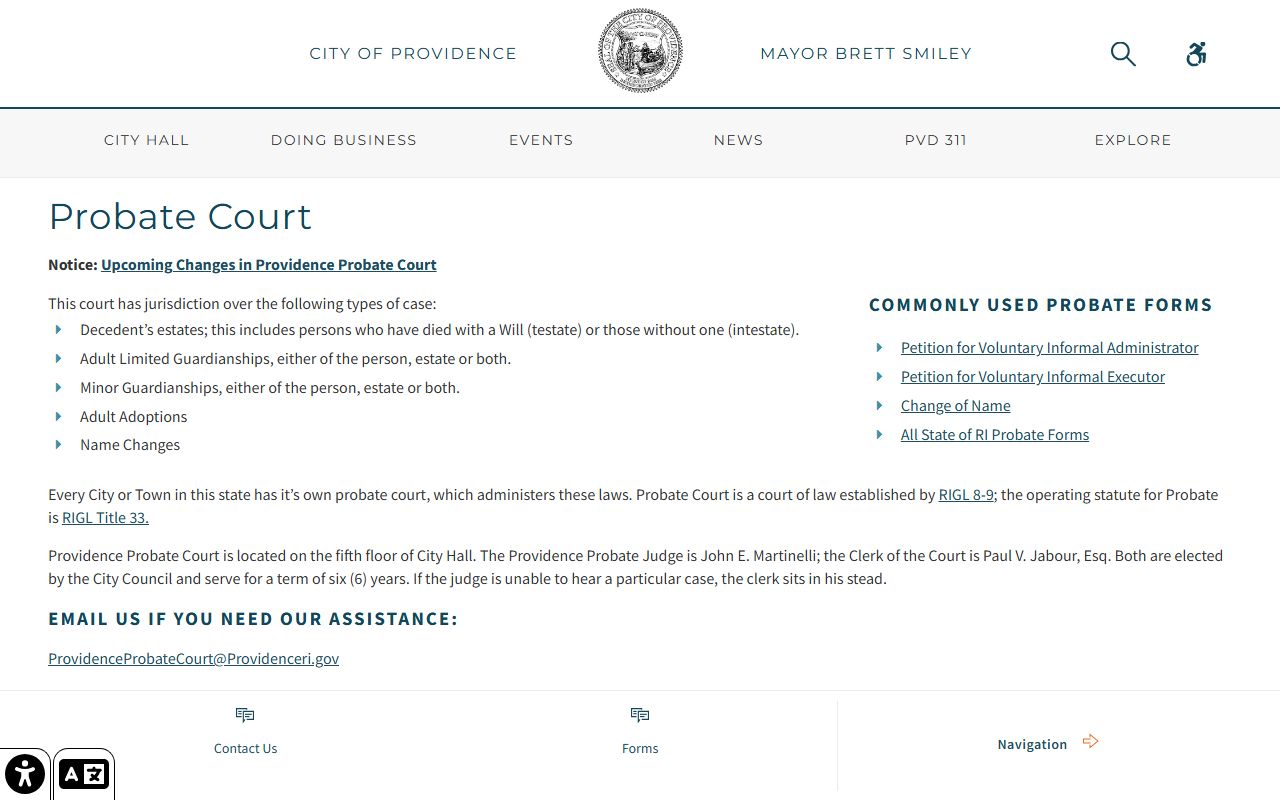
The Providence Probate Court page above lists jurisdiction, the judge and clerk, forms, and the fee schedule link.
Every City and Town Has a Probate Court
This is the key fact for any Providence County probate search. There is no single county probate court. The Providence Probate Court page states the statewide rule plainly: every city or town in Rhode Island has its own probate court. So probate venue depends on the city or town, not just the county.
That means a death or a guardianship in East Providence, North Providence, Pawtucket, Cranston, or Woonsocket goes to that municipality's probate court, not to Providence. Check the decedent's domicile first, then go to the matching court. Picking the wrong city wastes a trip.
This is different from most large states, where a single county probate or surrogate court covers the whole county. Rhode Island keeps probate at the city and town level, a tradition the statutes preserve. So the research trap is searching for a "Providence County Probate Court" that does not exist as one office.
Providence Probate Court Location and Contacts
The Providence Probate Court is at City Hall, on the fifth floor. The court names its judge and clerk, both elected by the City Council for six-year terms. If the judge cannot hear a case, the clerk sits in his place.
Providence Probate Court
City Hall, 25 Dorrance Street, 5th Floor
Providence, RI 02903
401-680-5000
Fax: 401-861-6208
The judge is John E. Martinelli, and the Clerk of the Court is Paul V. Jabour, Esq. Email the court at ProvidenceProbateCourt@Providenceri.gov.
City Hall is in downtown Providence, near the same district that holds the state courthouses. So a person handling both a state court matter and a Providence probate case stays in one part of the city. Still, the probate court is a city office, separate from the Licht and Garrahy complexes, so do not expect to handle a probate filing at a state courthouse.
What Providence County Probate Covers
Probate handles what happens to a person's affairs after death or when someone cannot manage their own. The Providence Probate Court lists its jurisdiction over several matters.
- Decedents' estates, both with a will and without one.
- Adult limited guardianships of the person, the estate, or both.
- Minor guardianships.
- Adult adoptions.
- Name changes for residents.
So probate is not only about wills. Guardianship and name-change matters also run through the same court, which is why the office handles a wide mix of cases.
Estate With a Will vs Without a Will
The first question in any estate is whether the person left a valid will. The answer changes who runs the estate and how. A will names an executor. Without one, the court appoints an administrator and state law sets who inherits. The table sums up the split.
| Point | With a Will (Testate) | Without a Will (Intestate) |
|---|---|---|
| Who runs it | Executor named in the will | Administrator appointed by the court |
| Who inherits | As the will directs | As state intestacy law directs |
| Main form | Petition for an executor | Petition for an administrator |
Either way, the court oversees the process. The difference is mostly about who is in charge and how the property is shared.
Probate Terms to Know
Probate uses old legal words that confuse many people. A short glossary makes the forms and notices easier to read.
- Testator
- A person who makes and leaves a valid will.
- Executor
- The person named in a will to settle the estate.
- Intestate
- Dying without a valid will, so state law sets who inherits.
- Administrator
- The person the court appoints to settle an intestate estate.
- Guardianship
- A court order giving one person authority over another's care.
- Conservatorship
- Court-ordered authority to manage another person's estate or finances.
Providence County Probate Forms
The Providence Probate Court links the common forms you need to start a case. It also points to the full set of Rhode Island probate forms through the Secretary of State.
Frequently used forms include the Petition for Voluntary Informal Administrator, the Petition for Voluntary Informal Executor, and the Change of Name petition. The court page also links administrative rules, decisions, the fee schedule, a claim form, and name-change instructions. Pick the form that matches your role and the estate type.
Use the right version for your town when you can. While the Secretary of State hosts the statewide probate forms, a city court may have its own cover sheets or local instructions. If a form asks for something you do not have, like a certified death certificate, gather it before you file so the clerk can accept the petition.
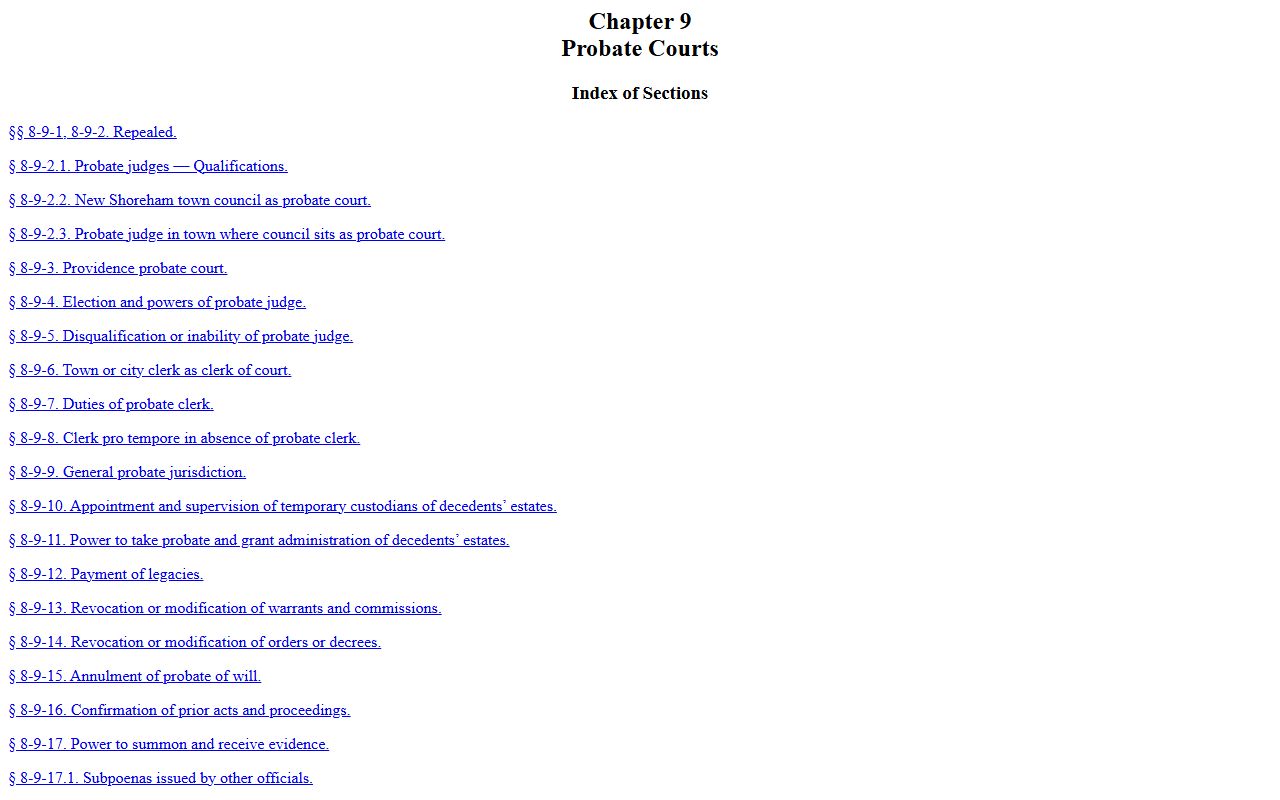
Title 8, Chapter 9 establishes Rhode Island probate courts, the legal basis for the local courts described here.
Providence County Probate Fees
Probate fees are set by each court's fee schedule. Providence posts its own payment schedule, and amounts depend on the filing and the service. Confirm the current fee with the court before you file, since the schedule controls the exact charge.
| Item | Amount |
|---|---|
| Estate and petition filings | Per Providence Probate Court fee schedule |
| Certified copies | Per court fee schedule |
| Name change petition | Per court fee schedule |
Because each city and town sets its own schedule, a fee in Providence may differ from one in Cranston or Pawtucket. Always check the court that will handle your case.
How Probate Works in Providence County
The steps follow a steady order. Knowing them helps you gather the right papers before you go to the court.
- Find the right probate court based on the person's city or town.
- Determine whether the person died with a will or without one.
- Pick the correct Rhode Island probate form for your role.
- File the petition with the death certificate, the will if any, and the fee.
- Attend any required hearing and give notice if the court orders it.
- Once appointed, the executor or administrator handles the estate and accounting.
The court then oversees the estate through inventory, creditor notice, claims, and distribution, and closes it when the work is done. The fiduciary, whether an executor or an administrator, carries real duties during this time. They must account for the assets and follow the court's orders. The clerk can explain procedure, but for legal questions about duties, an estate attorney is the right help.
Municipal Search Differences
Probate search tools vary by town. Some Rhode Island municipalities offer searchable, printable probate records, while others do not. East Providence, for example, mentions searchable probate records, which shows that online access is not the same in every Providence County town.
So do not assume a single statewide probate search exists. Check the specific city or town probate court for its own records and any online option. When in doubt, call the court that holds the file. Older Providence probate records also have historical indexes, since the city court has run for a long time. For deep family-history research, ask the court about its older index and any archive that holds early records.
Note: Probate venue and online access depend on the city or town, so confirm the right municipal court before you search or file.