
How to Find Providence County Arrest Records
There is no single Providence County arrest blotter, because the county does not run its own jail or police records desk. Instead, arrest and booking data spread across the city police, the state courts, and the state Department of Corrections. To trace a person after an arrest, you usually check two things. First, the court docket for the case. Second, the state inmate search for current custody.
Start with the RIDOC incarceration search for someone who may be held at the Adult Correctional Institutions in Cranston. Then use the Rhode Island Judiciary Public Portal for the criminal case. The two together give a fuller picture than either one alone.
Local police hold the original arrest report and any blotter for a Providence County arrest. Those are city records, requested from the police department that made the arrest, and they are separate from the court file. For a recent arrest, the police report and the court docket often arrive on different timelines, so check both over a few days rather than assuming one is complete.
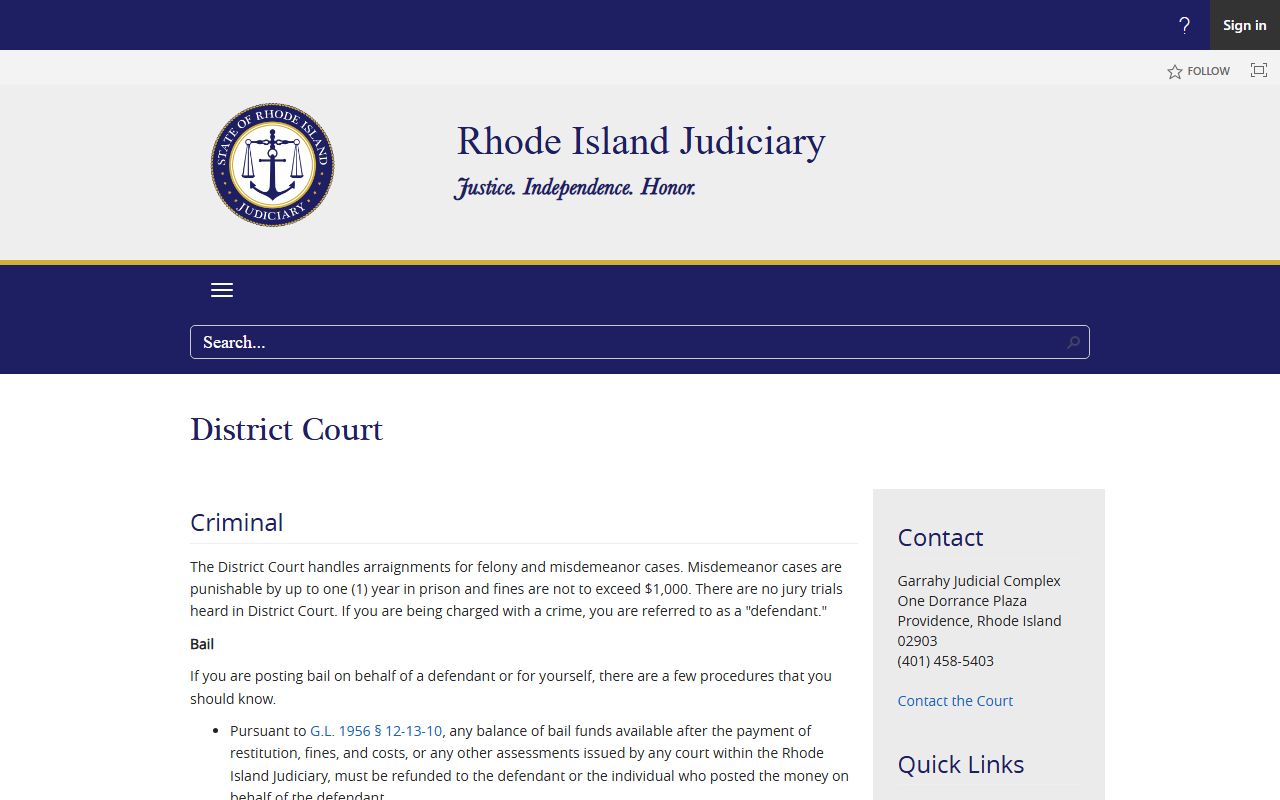
The District Court criminal page above explains arraignments, bail, failure to appear, and bench warrants, which are the first court steps after an arrest.
- Check the RIDOC inmate search for current custody status.
- Search the court portal by the person's name for the criminal case.
- Note the court, the charges, and the next hearing date.
- Visit the right clerk for documents the portal will not open.
- For older records, ask about background checks through the Attorney General.
Arrest and Booking in Providence County
After an arrest, a person is booked and processed. New commitments to state custody usually pass through the Travisono Intake Service Center in Cranston. RIDOC then classifies each person by custody level, housing, and program needs. Classification starts at arrival and continues until release.
The first court step is the arraignment. The District Court criminal page explains that arraignments cover both felony and misdemeanor charges, set bail, and address release conditions. A bail commissioner can hold a special arraignment when court is not in session, under R.I. Gen. Laws § 12-10-2. No-contact orders issue automatically in domestic violence cases.
Bail can take a few forms. A judge may release a person on a promise to appear, on conditions, or on a money bond. When a case ends, any available bail balance is refunded after deductions, under R.I. Gen. Laws § 12-13-10. RIDOC lists a Bail Information line at (401) 462-2261 for questions about posting bail for someone in state custody.
Arrest Record vs Criminal Court Record
People often mix these up. An arrest record shows that police took someone into custody. A criminal court record shows what the court did with the case. The two can tell very different stories about the same event, so it pays to read both.
| Point | Arrest Record | Criminal Court Record |
|---|---|---|
| What it shows | Booking, custody, initial charge | Charges filed, pleas, and outcome |
| Who keeps it | Police and RIDOC | District or Superior Court |
| Where to look | RIDOC inmate search | Judiciary Public Portal |
| Proves guilt? | No | Only if there is a conviction |
For the full case file, use the Providence County court records page. This page stays focused on the arrest and custody side.
Charges vs Convictions
A charge is an accusation. A conviction is a finding of guilt. This is the single most important distinction in any criminal record. An arrest and a charge mean a case began. They do not mean the person was found guilty.
| Term | Meaning | What It Does Not Mean |
|---|---|---|
| Charge | The crime a person is accused of | Not proof of guilt |
| Conviction | A guilty plea or a guilty finding | Not the same as an arrest |
| Dismissal | The case ended without a conviction | Not always a clean record until sealed |
Always read the disposition before you draw a conclusion. A case can show an arrest and a charge, then end in a dismissal or a not-guilty finding.
Which Court Handles the Case
The court depends on the level of the offense. The District Court Sixth Division at the Garrahy Judicial Complex handles arraignments for felony and misdemeanor cases. It also handles misdemeanor trials, which carry up to one year and fines up to $1,000, with no jury. Superior Court at the Licht Judicial Complex handles felony prosecutions, pleas, sentencing, and jury trials.
So a serious case may begin in District Court at arraignment, then move to Superior Court. The Superior Court page covers the felony side, and the docket entries on the court dockets page show how a case moves between them.
If a person misses a court date, the District Court page says the judicial officer may order a bench warrant. That warrant becomes part of the case and can lead to arrest. The page also warns that the clerk's office does not continue or reschedule court dates by phone. See the warrant records page for how to handle an outstanding warrant.
Mugshots and Custody Photos
Rhode Island does not run a public Providence County mugshot gallery. The state inmate search is the official custody tool, and it carries a clear disclaimer. RIDOC says the search is an informational service, not the official record, and staff will not confirm case details by phone.
Be careful with private mugshot sites. They are not official and may be out of date or wrong. For anything that matters, confirm with RIDOC Records and ID or the court clerk. The inmate records page explains the official search in detail.
A booking photo also does not prove a case outcome. It shows that a person was processed, nothing more. Pair any photo with the court docket so you know whether charges were filed, dropped, or resolved. That habit keeps you from reading too much into a single image.
Rhode Island Criminal Background Checks
For a formal criminal history, the state uses the Bureau of Criminal Identification within the Attorney General's office. The background check page explains how to request a record. This is different from reading a single court docket. A background check pulls a person's statewide criminal history, subject to the rules on what is public.
The Attorney General's Criminal Division prosecutes felonies statewide, since Rhode Island has no county district attorney. Federal crimes go through the U.S. Attorney's Office instead, and those cases do not show in the state portal.
The Attorney General homepage links the background check, expungement, and criminal division resources noted here.
Sealed vs Expunged Criminal Records
Sealing and expungement both limit public access, but they are not identical. A sealed record is closed from public view by order or statute. An expunged record is removed from the active public files. Rhode Island expungement is set by R.I. Gen. Laws Chapter 12-1.3.
| Point | Sealed | Expunged |
|---|---|---|
| Effect | Closed from public access | Removed from active public files |
| Still exists? | Yes, under restriction | Limited access remains for set purposes |
| Main law | Court rule or order | R.I. Gen. Laws § 12-1.3-1 |
Expungement does not erase a record for every purpose. R.I. Gen. Laws § 12-1.3-4 controls the effect and the limited later access.
How to Expunge a Providence County Record
Expungement is a court motion, filed where the conviction happened. The waiting periods are set by statute. Eligible misdemeanor first offenders may file after five years from the end of the sentence. Eligible felony first offenders may file after ten years. Crimes of violence and some offenses do not qualify.
- Confirm eligibility under R.I. Gen. Laws § 12-1.3-2.
- Pay any outstanding court costs unless the court reduces or waives them.
- File the right motion for a felony or a misdemeanor case.
- Give ten days' notice to the Attorney General and the arresting police.
- Attend the hearing the clerk sets at least ten days out.
The Superior Court FAQ says there is no fee for the expungement process. The Attorney General also keeps an expungement resource page.
Confidential and Juvenile Criminal Records
Some criminal records are closed to the public. Juvenile matters are heard in Family Court and are tightly restricted. Sealed cases, expunged cases, and protected personal data do not show in a public search. Domestic violence files may show the docket while keeping victim data private.
This matters for anyone running an informal background check. Public search tools do not show the whole story, and they leave out closed records by design. For employment, housing, or licensing decisions, use the proper background-check channel and follow the rules under the Fair Credit Reporting Act. An informal online search is not a lawful substitute.
Note: An arrest record is not proof of guilt; confirm the disposition in the court file before you treat any criminal record as final.